Thursday, June 11, 2020

Book Two, Rule Four for the Single Sword

Yeah, I know, I said I'd have this up a bit ago. These days though, time is a lie! So here we are.

Fabris opens up by saying that this rule is "also founded on an undetermined placement of the sword as you proceed against the opponent." Where rule three focused on proceeding to the outside when you could, this rule focuses more on the inside line, which Fabris points out "requires greater skill." 

To begin, our advance occurs with our chest square on to our opponent's point. This is essentially an invitation, as Fabris says that we really want to convey the impression that we're going to deliberately run onto their sword. This is explicitly to get them to keep their sword directed at our center line.

As we step into measure though, we step off to the side with the foot we enter with. If we're stepping in with the right foot, we step off to the right. If we're stepping in with the left, we step off with the left. When we do this, we'll lean our body off in the same direction, removing it from the line of our opponent's sword "while the opponent's openings will now be open to [us]."

We're keeping our sword near to our opponent's, so we can defend ourselves easily if they attack us as we enter measure. If they don't do anything, we keep going on the side we've already stepped toward to close them out of line completely, and wound them as we take a second step.

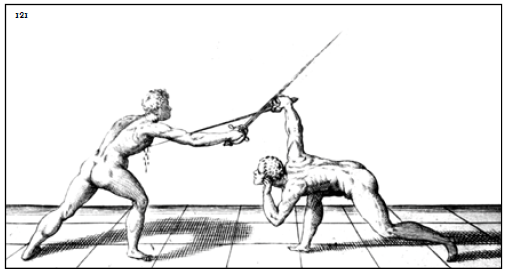
If instead our opponent follows our body with the point of their sword while we're taking that first step off line - and this is a pretty neat action - we move forward with the other foot (which Fabris notes "by then should be in the air") and bend our body over it so we move off line to the other side. Then we just go forward and wound them.

Fabris says that these processes are meant for when our opponent keeps their sword point in line with our upper body, more or less. If their point ends up "directed against [our] knee, or even lower" we just move forward straight against it and close out their blade downward with our blade on top, such that they can't lift their sword. When we do this, we need to be very sure that our hilt is what lowers the most, and that our point does not fall underneath their blade at all. If that were to happen, our opponent could wound us with an easy cavazione, since we'd need to perform a contracavazione at close measure. If our point is correctly situated relative to our opponent's blade though, we can wound them while they try to perform that cavazione.

Finally, Fabris notes that if our opponent is to the outside, we shouldn't need to adjust our hand. If they're on the inside though, we'll need to turn our hand slightly into quarta, but be careful not to lower our hilt and create an angle that we could be wounded through.

That's... that's it. It's really short. It's deceitfully straightforward. It also has twelve plates following it up, and I spent a good amount of time flipping back and forth between this section and the plates, trying to make sure that I was visualizing things correctly, which is what most of the next post is going to be. Also, lots and lots of plates.


Monday, May 25, 2020

Intermission: The Warrant for the London Masters of Defense

It's been a while since my last update, and I've still got my notes on the next set of Fabris' rules to go through. As we all know though, things are kind of a mess right now and it can be really hard to accomplish anything.

So just to keep posting anything, here's the text of the Warrant that Henry VIII signed on July 20, 1540 to form the London Masters of Defense, because it's interesting!

Ric. Beste, Humph. Bassett, Rob. Polmorth, John Legge, Peter Beste, Philip Williams, Ric. Lord, John Vincent, Nic. de la Hay, masters of the “Science of Defence,” and Will. Hunt, John Frye, Hen. Whytehed, Gilbert Bekett, Edw. Pynner, Thos. Tourner, Jeffrey Gryffyn, Thos. Hudson, Thos. Tynosey, Hen. Thyklyppes, and John ap Ryce, provosts of the same science. Commission to enquire and search, in all parts of England, Wales, and Ireland, for persons being scholars of the said science of defence (many of whom, regardless of their oaths made to their masters on first entering to learn the said science, upon the cross of a sword in remembrance of the Cross whereon Our Lord suffered, have for their own lucre of their “unsaciable covetous minds,” without sufficient licence, resorted to all parts of England, keeping open schools and taking great sums of money for their labours, and yet have insufficiently instructed their scholars, to the great slander of the masters and provosts of the science and of the good and laudable orders and rules of the same), and to take any scholar so misusing himself before the nearest justice of the peace to be bound in sufficient sureties not to repeat his offences against his said oath and the said orders and rules, or in case of refusal to be committed to gaol. Westm., 20 July 32 Hen. VIII. Del. Westm. 20 July.—S.B. (In English.)


It's really interesting to see that it isn't about going out and teaching, but about going out and dragging off teachers who are misrepresenting themselves or not teaching sufficiently well and punish them for it.

Huh!

Okay, we're going to try to get the first post up for the Fourth Rule for the sword alone by the end of the coming weekend.

(Be safe, everyone. Okay?)

Wednesday, March 18, 2020

Book Two, Rule Three for the Single Rapier, the Plates

Ugh, more than a month for a break? Not cool! Anyway, no changing that so let's just work our way forward by looking at the plates that Fabris included for Rule Three of the sword alone.

Diving right in, we have plate 124! We're the fencer on the right, standing over our left foot, having just stepped into measure and found our opponent's sword on the outside. Up until now, our initial entry has been performed with the right foot leading, and I'm happy to see an example of it happening with the left. (I know at least two southpaws who are reading this right now and giving me dirty looks. What can I say, I'm just being true to the source material here.) This can happen pretty readily when you're approaching with a natural step whichever rule you're applying, so seeing it finally show up in a plate is great. While our fencer is passing their left foot forward, take note of their body mechanics, specifically their feet and hips. Their feet are aligned as you'd expect from a "regular" fencing guard, with their right foot pointed forward and their left foot pointed to the side, even though they're passing the left foot forward. This allows for the hip orientation that you see, which leaves the right side hip oriented towards their opponent. This is really important for us because it preserves our measure as well as the body mechanics we need to meaningfully oppose our opponent's blade, should it come to that. (Try it, though. Pass forward with your left foot but reorient it so that it's pointing more forward. Your hips will very likely relax some, your right hip will drop, and you'll lose range. If you have a partner, have them try to push your extended hand around, and it'll be a lot harder to resist the pressure. Body mechanics are really important, people.)

Ahem, right. Anyway, Fabris tells us that we're to proceed into measure without a guard and find our opponent's sword as we place our foot in the "danger zone." (Yes, I know.) We're to keep our opponent's sword covered without touching it and just proceed to and through our opponent. If they give us a tempo, we take it. Otherwise we just keep proceeding along forward, "with good union of sword, feet and body."

The next plates are laid out in no particular order, and Fabris really just kind of free-forms his way through some what-if problems. Taking a look at the next one, we see "what if when we move to find their blade, our opponent performs a cavazione into a high fourth with a girata?" In this case, Fabris wants us to simply turn our hand into fourth as well, pushing through our opponent's blade and wounding them in the throat. He points out the inherent structural weakness of the girata in terms of being able to oppose our blade - that plus having the advantage of having found them means that we can displace their blade fairly easily. Also, note the position of our arm - we're pushing his blade off to the side fairly strongly, which both ensures our safety as well as moving our blade farther to the inside so as to be able to successfully wound our opponent as they have rotated their body out.


Here we have a similar response, with our opponent turning their hand into fourth and attempting to drop their tip and strike us underneath our guard. The solution that Fabris gives us shouldn't really be a surprise at this point - drop our body and turn our hand into second, wounding our opponent underneath their guard while we shut them out entirely.

The next two plates flow together, one after the other, so let's do that. We approached without forming a guard until we hit measure, and we end up in a fairly high angled third. (Fabris doesn't specify if we're on the inside or outside though; from squinting at the plates, it looks like we're on the inside and frankly, the actions he suggest imply this as well. I know, the rule has us approaching from the outside, but here we are.) From here, we've covered our line, and we're in a pretty safe position. If our opponent doesn't do anything, we can just extend into fourth and proceed through to striking them like we all want to be able to. If they cavazione, contracavazione and strike them in fourth anyway. (I'd suggest extending your arm as you go though, so as to be able to perform a sufficiently small contracavazione.) On the other hand, if they cavazione and you're sufficiently close to them - say it with me now - turn your hand into second, lower your body, and pass underneath their sword to wound them.


Here's the last plate we have for this rule! It's a little complicated and the stance makes it look worse than it is, but honestly? It isn't anything that we haven't seen before, and the stance is just a passing step caught in a snapshot. We're approaching to the outside in third, and this time our opponent tries one of our usual techniques - they turn their hand into second and try to wound us underneath our sword as they push forward with their right leg. To counter this, we lower our point and body both, bringing our sword down on top of theirs as they are moving their blade and coming forward.

If in this case, our opponent tries to push back against our blade by turning back into third, we can simply turn into second to shut him out completely and push forward. If they try to cavazione back to the outside in second, we will - and stop me if you've heard this one - turn our hand into second, lowe our body, and strike underneath our opponent's sword.

Fabris closes by taking the time to point out that these actions will succeed not solely because we're in third and obliging our opponent to move to defend themselves, but also because we have the advantage of already being in motion, which is a clutch point that much of Book Two rests on.

That's the Third Rule! The Fourth Rule is a really long one, so I'll get crunching on that as soon as I can. I may take a break to touch on anything that's come up in the first three, or any other things that occur to me just to clear my head, and then dive into it.

I was also planning on preparing a look at all of this for a Laurel's Challenge event near the end of April, but well... that's not happening now. An online substitution may well end up happening instead, and while I'm not sure what format my material might take then, it'll be interesting to put together.

Saturday, February 8, 2020

Book Two, Single Rapier, Rule Three

Let's make some progress here! With this, we're hitting the halfway point of the rules for the sword alone.

No need for more of an introduction so here we go!

Fabris opens by touching on some advantages and disadvantages of the first two rules. For the first rule, he says that it is good because it lets us gain an advantage from farther away. On the other hand, he says that we might give away our strategy too soon, and that our opponent could manage to change things up enough or otherwise find the time to somehow save themselves. This seems fair, and it does square with the instances in which Fabris tells us that we may need to withdraw and try again, or that our opponent could retreat enough to effectively break engagement.

The second rule he describes as good because it really only allows for a single opening, which is close enough to our sword hand that our opponent can't attack it without essentially attacking through our forte. Because of this, we've reduced our decision tree to "our opponent does a really bad idea for themselves" and that's that. It also keeps our sword free and we don't need to worry about performing lots of cavazione, unlike the first rule. On the other hand, he describes it as "laborious" and keeping the arm almost completely immobile is just plain tiring after not all that much time.

Keeping these issues in mind, Fabris describes the third rule as one that will not give away our strategy until far too late, so that our opponent will not be able to move themselves or parry until it is too late. The method that Fabris tells us will accomplish this is this: since our opponent by definition can't wound us until we're in measure, we will not assume a guard at all until we are stepping into measure. We will be approaching our opponent to the outside without being in guard or having our sword in any particular position. As we are stepping into measure with either foot (Fabris specifies "when you lift your foot to step into measure") we will place our forte against our opponent's debole to shut them out of line without stopping, at which point we - as we might expect - are to run along our opponent's blade with our sword without stopping or flinging out our arm.

There aren't any specific details of stances and movements there, but given that we aren't told to form any specific guard as yet, that makes sense. Still, it does feel like it's more theory and less application as yet, so let's see where we go from here.

Fabris then tells us that if we end up on the inside and our opponent tries to parry we - and this will not remotely surprise people who have been reading along up to this point - "should change from third to second, lower [our] body as [we] proceed forward and wound [our] opponent in the tempo of the parry." Nothing remotely surprising here, and in fact this is pretty much right out of rule one, as well as other plays that Fabris illustrates in the first book of his manual. Fabris points out that our opponent will not be able to bring his point back into line but does state that if we have any hesitation or break in our motion after we find their sword then our opponent will be able to find the time to return their blade to line because of that slowing of our action.

So far, so good. Straightforward and we don't have any real surprises yet.

Fabris says we can apply "the same resolution" in passing if our opponent tries to parry without breaking measure as we find their sword - just turn to second underneath, and pass to wound them before they can apply any pressure to our blade. On the other hand, if they retreat as they parry we should cavazione before they touch our blade. This will essentially place us in a starting position, albeit on a different line, and we can continue as normal.

At this point, Fabris points out that we want to avoid "making any motions contrary to a cavazione." For instance, if we make the first motion toward our opponent's blade, we cannot also cavazione in that tempo. If we suddenly lower our hand, we can't bring it back up. In general, this is good advice to remember, but when we're playing games with collapsing our measure and tempo like this, we can't afford to waste any motion.

He goes on to describe how, if we have good enough control over our blade to be able to change the original motion into another one, we can "perform a splendid deception" on our opponent. (Sounds like feinting but okay Fabris, let's hear it.) "As soon as you place your foot in measure, you gain the opponent’s sword. As he tries to meet your blade and resist to it, you deceive him with a cavazione and proceed forward with the other foot, so that he cannot return in line. All he can do at this point is to try to wound you under your sword with a half-cavazione, but you can avoid this danger by simply lowering your point and your body to the same side of his sword. This keeps him out of line as you push your attack home." Okay that's... pretty straightforward and not out of keeping with anything we have so far, really. It seems a bit more... hm. Proactive is the best word I can come up with off the cuff as I write this, but I'll work on it. It seems a bit more proactive than how Fabris has set up his rules so far, which generally seem to be more in the vein of "I have placed my opponent in a no-win scenario and have a response for whatever they might do" as opposed to "I'm going to feint on the way in" but even still, I can get there.

Fabris then says that if our opponent performs a cavazione as we find their sword, or comes forward, we'll just wound them in that tempo. If they break measure as they cavazione to find our sword, we should just contracavazione and keep right on going forward and wound them. If they change their guard while breaking measure, we keep moving forward but we place our sword against theirs such that we can keep running our sword along theirs. Light on details, but straightforward enough with what we've seen in the previous rules.

Moving on, we are told that we should keep the measure in mind, and that it should make us aware of potential offenses or defenses that we might see, and that we should be prepared for them. Sure, okay, good advice but again, not so much with the details.

Fabris does say that he's not going to discuss what to do if our opponent completely breaks measure or they just lean away, because they're not threats. Likewise if they try to cut, we can wound them as they prepare the cut and that's that. If they're moving away as they do this, he says that we can just parry in fourth or second or void the cut and strike them.

He closes by pointing out that this rule requires a very refined understanding of measure. This certainly seems true, as we need to be able to know when we are about to enter our opponent's measure so that we can be entering a guard as we do so, and to be aware of what our opponent can accomplish at any point in the closing of measure.

All that said, this rule so far really reads to me as what would happen if the first rule had a lot of the flowcharts stripped out of it and more or less simply had "do what you need to do" added in. This would be terrible as a first rule, but in terms of following the first and second, it really seems much more like presenting an alternate way to implement the principles that we saw in there, which is great.

Soon, the plates!

Thursday, February 6, 2020

Book Two, Rule Two of the Sword Alone: The Plates

It's been long enough, so here we go! Let's look at the plates for rule two of the sword alone. I think that in general they're a lot more straightforward than those for rule one, which I also think is true of this rule overall. In rule one we had a flowchart which was somewhat complicated, at least until we got it all down on paper. Rule two really just concerns itself as to whether your opponent is on your inside or outside and what you should do in either case. Measure isn't explicitly mentioned, and even implicitly isn't as detailed as how it was covered in the first rule. It isn't as though measure doesn't matter, but it's not the primary principle being used here.

Almost as if each of these rules, while potentially standalone, are also examples of different areas of focus for the principles which will allow you to proceed towards your opponent with resolution. Super weird, right?

So let's get to it!

Like we saw previously, this plate is an example of our initial guard position. It removes the lower torso from measure and presents the head, as it keeps both the guard and forte of the sword as well as the empty hand by the face to protect it. As we can see, easily finding the sword is made difficult by keeping it initially quite high, and the squared-off body ensures that you can really only be attacked to the inside. All of this means that you can set up a fairly predictable set of actions from your opponent, which will in turn ensure a predictable decision tree for yourself.

Plate 118 illustrates the next step in this process. As Fabris has previously described, we've lowered our body while keeping the same position of our arm relative to our torso, which brings our sword down to meet our opponent's. This plate also shows one extremely key component of this position - the relative distances of each fencer's body to their swords, and how that impacts the dynamics of the fight. This is kind of a big deal, so let's take a short trip down this rabbit hole before we get back on track with what Fabris explicitly tells us here. (Which also touches on this as well, so it all works out!)

The relative positions of the blades themselves are pretty standard when you think about it. This is where Fabris wants us to get as a general rule - our hilt down by their debole, which is a great position to be. In the plate though, you can see that our head is about as close to our opponent as our hilt, which is in stark contrast to the relative positions of our opponent's hilt and head, where there's a full arm length of space between them. What does that do for us?

So first off, for what is probably the majority of fencers out there, measure is taken from the opponent's sword. There can be a whole lot of problems with that, but I don't think that I'm particularly off base here. What this means is that yeah, your body is probably a lot closer than a lot of people will expect; certainly, it's a lot closer than the relative blade positions will indicate. The upshot of this is that getting your body past the point of your opponent's sword will be a lot easier, especially with the fact that you're constantly moving forward. By the time they cavazione, your torso will have moved past their point, which dramatically reduces the danger that you're in.

In addition to that, remember that your blade is farther out to the side than usual. What this means is that if you've managed to approach to the outside as Fabris tells you to, you're going to force your opponent to take a larger cavazione to get to your inside line and threaten you, and an even larger one than that if they're going to find your blade as part of that motion. Essentially, you're forcing them into a larger and less efficient action if they want to move inside your blade, and you're for sure going to take advantage of that.

Anyway, back to what Fabris says! He notes that with this arm position, if your opponent performs a cavazione that "your body will be as far forward as your opponent's mid-blade." So that all tracks, and a subsequent plate will show us what happens there. Additionally, he notes that if your opponent tries to find your sword, you'll be situated to pass underneath their blade - which we're about to see!

Here we are at Plate 119, and here we are passing underneath our opponent's sword!

Fabris points out that if our opponent is in a higher guard when we move from the situation in the previous plate, this is more or less where we can end up. Note that we can make out our sword being on top of and controlling that of our opponent's. If they're in a lower guard, Fabris tells us to just lower ourselves to match, which we'll see by the end of this series of plates. Finally, he points out that if our opponent tries to parry and raise their sword, we can turn our hand into second and cavazione underneath their sword and wound them from there, an action which we've seen before.

What if they cavazione to the inside? Here we go! You "lean against the opponent's debole with a fourth." I really like the use of the word "lean" in this description. Look at how our fencer has dropped their hip and turned their body into their opponent's blade to bring it into a fourth. Fabris points out that the right foot is "somewhat out of line" which just adds to the full-body pressure on the sword. He also makes sure to point out that we should "continue all the way to the opponent's body so as to complete the pass" because of course he does. He also notes that if our opponent attempts a girata to save themselves then their defense will actually be weaker for it and they will be able to be wounded in the flank or even the back.

Next up, we show what happens if as we approach to the outside, our opponent's initial action is to raise their hand to parry. Here, we should turn our hand into second before their blade touches ours and lower our body to wound them over their blade and arm as our head and body pass underneath their blade.

As a note, take a look at the orientation of the feet. The hip and body position that this allows is really helpful for getting your body to twist into that position more easily and, let's face it, when it comes to these postures I think we'll all take every bit of help that we can get.

Finally, we're going to look at the last two plates together, because they're essentially a before and after set of shots. Like we've been told before, if our opponent takes on a significantly low guard, we should lower ourselves to match them, and that's exactly what we're seeing here.

We're pulling our right side back - check out that foot and hip orientation again! - and with good weight distribution so we can move forward smoothly.

From there, we end up in the final plate in this rule. Once we get to our opponent's blade, we run up it, here in fourth. If they cavazione, we can pick them up in third on the outside easily. If they raise their blade high, we stay in fourth but end up looking more like Plate 120 as we rise up but remain in fourth.

There we have it! Rule two for the sword alone. Body position, body mechanics, and moving around the point of our opponent's sword are on display here, and they are all really clutch concepts to stay safe as we stroll unceasingly towards our opponent.

Wednesday, January 22, 2020

Book Two, Single Rapier, Rule Two!

We've made it through the holidays, the holiday funk, the post-holiday illnesses, and the post-holiday funk and here we are, back at it and looking at the second rule of Book Two!

This one is where we start to get a little weird. Fabris describes it by saying that "[t]he principal guard pertaining to this rule is a third formed with the body positioned squarely toward the opponent, the chest wide open and the feet pointing forward. The body is curved and the sword-hand is held near the face. The sword-point is suspended in the air and kept somewhat forward, but not so far forward as to enable the opponent to find it without coming into the misura stretta." The description is pretty straightforward, but just because the first time I read it my reaction was something like, "Okay, I can picture this pretty well but that can't be right..." here's the plate from later on in this rule which illustrates it:
Nope. I wasn't kidding. It's a little weird, right?
Yup. Just like that - squared off, your hilt and forte up by your face, and your off-hand up by the other side of your face.

We still have the signature hip hinge, with the lower body voided back. We might square off a little if we're using a dagger or cloak, but not at all to this extent. So what is Fabris thinking with this? What's his plan?


The clutch piece of information for using this initial guard for proceeding with resolution is that you initially want to do your best to move towards your opponent on the outside. Circle a bit if you need but try very hard to be on that outside line to the point that "even your sword is out of presence to that side." As you approach your opponent lower your body while keeping your arm in the same position relative to your body, such that when your hilt is by their point, your blade should be in line with them. Do not extend your arm to strike, but keep it in that position and wound them by stepping forward and passing your blade through them that way. (We'll go into why this is a thing later on in another post.)

What if you can't move to the outside because your opponent just won't give you that line? In that case, place your sword to the inside but don't extend the arm in there, either. You'll stay more squared up than not, kind of, but turn your body from the hips to get your blade to cover the inside line. Lower your body, but again, keep your arm in the same position relative to your torso.

Finally, if your opponent keeps their sword really low, just (ha ha, "just") drop your body low enough such that your sword can close theirs out on either line. Fabris does note that if they're positioned to the inside of your blade, you should turn your right side away in a void as you lower yourself.

Fabris goes on to note that you should not use cavazione in this guard save for if your opponent tries to bring his point high to find your blade. In this case, you perform a cavazione of sorts, but not through a motion of the hand or arm - rather, you withdraw your right side similar to what he described in the previous action, which pulls your sword back and keeps it free. As you do this, advance and step off-line with your left foot, which will turn you such that your opponent is now on your outside, and you can proceed in to wound them.

If your opponent tries to parry you, turn your hand to wound them underneath their sword, similar to the previous rule.

Fabris finally notes that while your face and inside are somewhat open, your left hand will protect your face, and if your opponent feints to the inside, you again cover yourself by turning the body rather than moving your arm.

We'll take a look at the additional plates in the next post, which will help illustrate why keeping your arm in the same position is helpful in this rule. They'll also help show us what is to be gained by turning our bodies to cover ourselves, rather than moving the arm. Spoiler: they help us move our torso (which is filled with squishy organs which should not be pierced) around our opponent's point.

Wednesday, December 11, 2019

Wrapping up the first rule for single rapier, and drills for learning it!

So through our last four entries, we looked at some general concepts that Fabris uses in Book Two, and then went through a solid look of his first rule for the sword alone, both text and plates. This entry is pretty much a final wrap for our look at the first rule and some thoughts on it as well as the concepts we're seeing Fabris discuss here, using the first rule as an example of that. Finally, we'll close with some thoughts on how best to drill and practice this rule. This is going to be a bit of a badly-ordered shotgun approach to commentary but here we go!

Do these techniques work?

Yup! They can and do. I've pulled them off, I've seen a couple other people pull them off. That said, they are very hard to do well. You really need to maintain that constant forward movement and if you hesitate, even a moderately skilled opponent will probably grab that tempo away from you. Even if it isn't a useful action, or a flinch or panicked movement, it'll be enough to throw off the entire play.

Things to keep in mind!

Keep. Going. Forward. No, really. Don't parry, but cover ahead or yield and strike and trust your defense. This is probably the hardest thing to really internalize. That said, this does bring up if there are...

Any SCA-related concerns about Book Two?

There are some, yeah. They aren't safety related as such, but are more about the functionality of the technique.

First we have issues with the physical space that you're fencing in. You need to start out of measure, so if the list is too small, this isn't really an option to use. Most of the time though, lists at the smallest are probably just big enough for you to reasonably attempt using Book Two. What comes up more often are the dreaded list ropes.

If you're in a tournament and you want to use Book Two, you need to know what the rules regarding list ropes are. If a combatant hits the ropes and the rule is to call a hold and recenter, someone who doesn't want to deal with your Book Two Weird Stuff never ever needs to. Granted, this could be a common issue with any kind of fencer who just keeps backing off, but I find that it tends to come up more when faced with an opponent who just keeps walking towards you and doesn't ever stop. Backing up seems like a really great option if you're trying to figure out what to do, and if recentering happens, well, yeah. (Essentially, my understanding of dueling culture in Italy was that if you backed up out of the circle, you both lost and looked like a coward - so combatants had a pretty big disincentive against just backing away from you.) So it's just something to keep in mind.

Similarly, opponents who make really noncommittal attacks or defenses can sometimes be hard to work against with these techniques, though as we'll eventually see, some rules function better than others in those instances. That said, as long as they present their blade in a guard, you'll still have something to work with, even if flushing out a reaction is more difficult.

Additionally, there is a tendency in the SCA as well as other modern rapier combat groups to dislike having your blade pass completely through peoples' bodies and up to your hilt, as Fabris advises.

I know. It's really strange, right?

Regardless, it can lead to some positions where you might not be able to get as far past your opponent's point as you'd like, and you might be left in some risk if they push for a double kill or something like that. In cases like this, you probably have a couple options, which can be used together or separately. First, you can continue forward with your body, but collapse your arm. This could well get you into a safer position. Second, you can turn your guard into a position which more securely covers you from your opponent's blade. This might not work as well when you're yielding around their blade, but in instances where you're passing underneath, turning into prima can be extremely helpful.

Finally, there are occasions where someone just... well, panics. Or does something strange or unwise that Fabris didn't consider. What do you do here? Frankly, a lot of the time, the answer may well simply be "continue forward and strike your opponent, and maybe turn your hand into a guard to cover if you have the tempo for it." The reactions that Fabris describes are both the most likely reactions, and the most reasonable reactions in terms of usefulness and the tempo that they give up. If someone does something that's an extreme and outside those possibilities, they're almost certainly also extremely inefficient actions, which means that you'll have a relatively longer time to react. As long as you continue forward and react in a way in keeping with Fabris' system and the rule that you're applying, you will probably make the correct choice and end up okay.

How can I practice and drill this thing?

Let's face it, this is probably what you're really here for, right? Okay, let's get to it.

Initial concepts for our drills!

Fabris tells us to use “ordinary steps” to approach our opponent, so we’ll rely on passing steps for our drills. While he also says to bend your body while raising and extending your sword as you approach your opponent, we’ll dispense with that for the time being so as to reduce the number of details you’ll need to keep in your head.

For measure, there are essentially three stages to approaching our opponent and for consistency we should consider the positions of our feet at each point. First, there is the moment when your point is just beginning to cross your opponent’s blade. At this point, your feet should be in their natural position, with the right foot leading. As you close, your off-side foot will pass ahead. Finally, your sword-foot will pass ahead and you will strike your opponent. If you need slightly more reach, at this time you can take a more extreme step or even a lunge.

Broadly speaking, we’ll be working with the steps between each of those points for these drills - as we move our left foot ahead of our right, and again as we move our right foot ahead. During those steps is when our partner will take the actions we’ll be responding to. When we begin these drills those actions should be quite slow, so as to assure that we can respond while our partner is moving, not after. Fabris’ comment on this is “Carry your sword so close to the opponent’s blade that when the opponent’s sword moves, it will seem to be tied to yours: in other words, one sword’s movement should be quickly followed by the other’s.” We want actions to occur in the same tempo rather than one after the other.


Drill Conventions

For the purposes of explaining these drills, there are a few conventions to keep in mind. They will be written assuming that you, the reader, are the person proceeding with resolution and that your partner will remain stationary. For ease of learning and performance, both you and your partner will be in Fabris’ extended guard. Begin all your approaches from out of measure, but work them out such that when your swords are just crossing that your right foot is leading, as shown in Plate 109 here; explanation of the drills will begin from this point.. Finally, in the beginning take each step separately, but build towards performing them smoothly before worrying about speed. Let’s begin!

Initial Approach

Approaching Your Partner on the Inside
  • From your initial approach, find your partner’s sword on the inside.
  • Take your first passing step. Begin forming a more distinct terza-quarta bastard guard to consolidate your finding to the inside.
  • Take your second passing step, leaving your hand in the terza-quarta bastard guard as you strike your partner. 
    • You are running your blade along and on top of your partner’s blade; in this instance you should not need to turn fully into quarta, though doing so is absolutely permissible if that’s what you need to close the line.
Approaching Your Partner on the Outside
  • From your initial approach, find your partner’s sword on the outside.
  • Take your first passing step. Remain in terza for this; you can successfully control your partner’s blade from that guard.
  • Take your second passing step, striking your partner. 
    • Note that you will be remaining in terza and as such you will be forcing your partner’s sword down and dominating them from above, rather than pushing them upward as with seconda or quarta.
Variations: As you take your second step, your partner may withdraw their body, leaning back, in an attempt to not be struck; you should step into a lunge to ensure you successfully strike them.

Notes: These are the fundamental actions that every other drill will be based on. In this case, there is only a single minor point of difference as to whether you begin on the inside or outside line. As the drills grow more complicated, the line you begin on will have a greater impact on how the drill progresses.

Reactions in Wide Measure

At this point, the drills will take their first complication, that of your partner performing an initial action while you are approaching from wide measure.

Your Partner Cavaziones
  • Approach your partner having found their sword as above.
  • As you take your first passing step, your partner performs a cavazione. 
  • As they perform their cavazione you should contracavazione. 
    • This should place you back on your original line as you finish your step, just as you were in the initial drill above.
  • Continue with your second passing step, striking your partner.
Your Partner Pushes
  • Approach your partner having found their sword as above.
  • As you take your first passing step, your partner pushes against your blade in an attempt to counter-find or simply to push you off-line. 
  • As they begin to push, you should cavazione to the other line.
    • If you began on the inside line, you will now be on the outside line, and vice-versa.
  • Continue with your second passing step, striking your partner.
    • Remember that you are on a different line than you began in; adjust your guard accordingly!
Variations: As above, your partner may lean backwards at the conclusion of the drill to prompt a clear lunge.

Notes: These options are the first set of possible reactions from your drill partner. We are spacing our partner’s reactions out based on our measure, and will be building out longer plays from there!

Reactions in Narrow Measure

When we enter narrow measure, our partner really has only one reaction that they can make - they push against your blade. While the reaction to the push on either line involves the same guard, it is utilized differently for each line.


A Push From the Inside Line
  • Find your partner’s sword on the inside and approach them as usual. They will not react for your first step, allowing you to close to the edge of narrow measure.
  • As you take your second passing step, your partner will push against your blade in an attempt to parry you or simply push you off-line.
  • As they begin to push turn your hand into an angled seconda so as to yield around their push. Their blade should well fall into the space you create with the angle of your blade.
  • Finish your step and strike your opponent.
A Push From the Outside Line
  • Find your partner’s sword on the outside and approach them as usual. They will not react to your first step, allowing you to close to the edge of narrow measure.
  • As you take your second passing step, your partner will push against your blade in an attempt to parry you or simply push you off-line.
  • As they begin to push turn your hand into seconda while you perform a half-cavazione and drop the point of your sword under their blade, without moving your hand’s placement relative to their blade. 
  • Finish your step and strike your opponent.
Variations: As before, your partner can lean back at the conclusion of the drill in an attempt to avoid your blade, prompting a lunge.

Notes: Fabris really only considers pushing your blade aside as a reasonable reaction at this point; he doesn’t even consider performing a cavazione at that measure as remotely reasonable.

Putting It All Together

At this point, drilling this rule takes on a bit of an IKEA assembly feel. We have our choice of options at each measure:
  • Wide Measure
    • Do nothing
    • Cavazione
    • Push
  • Narrow Measure
    • Do nothing
    • Push
Additionally, all of these options can occur on the inside or outside line, adding more options to what we can put together.

What we want to do at this point is assemble an entire flow from beginning to end, using the options above. For instance, we could assemble the following process:
  • Start finding your partner on the inside line.
  • At wide measure, they cavazione. The proper response is to contracavazione.
    • This leaves us on the inside line.
  • At narrow measure, they push. The proper response is to yield in seconda.
  • Strike your partner.
Or we could choose different options!
  • Start finding your partner on the outside line.
  • At wide measure, they do nothing.
  • At narrow measure, they push. The proper response is to turn underneath their blade in seconda.
  • Strike your partner.
Work with your partner and create a script in advance and work through it. The goal here isn’t to get used to making decisions in the heat of the moment, but to get used to two things. First, you’ll learn how the decisions would look and feel as you flow through an entire approach. Second, you’ll learn how to move from reaction to reaction as you go. Again, run through them step by step, and work on making the actions smoother, not faster.

Additionally, you can discuss with your partner what could cue them to take one action over another. Why might they push against your blade rather than cavazione? Is there anything you could do that might cause them to take no action at all as you approach?

Advanced Options

Once you are comfortable running through fully scripted flows, you can begin to introduce choice. Do this more gradually than you think you need to - it’s extremely easy to introduce too much cognitive load too quickly, which will just lead to frustration. Also, be prepared to slow the drill back down, simply because you will likely be actively thinking about and considering your options, rather than reacting reflexively. Being thoughtful is good at this point, but it isn’t fast. Finally, remember that the choices you add will cascade further down the flow - for instance, if you introduce the possibility of changing lines during the wide measure, at narrow measure you will need to be prepared for the inside or outside option.

Consider this as an initial drill idea:
  • Approach your partner as usual. When you cross wide measure, your partner may cavazione or do nothing.
    • If they cavazione, you will contracavazione during their movement.
    • If they do nothing you will begin running your blade along theirs.
  • When you reach narrow measure, your partner will do nothing. You will continue running your blade along theirs and strike them.
This is extremely straightforward! Note that whichever option your partner chooses, you will end up on the same line that you began in, which further reduces the cognitive load that you are introducing.

If you want to complicate it further, add a single choice further in:
  • Approach your partner as usual. When you cross wide measure, your partner may cavazione or do nothing.
    • If they cavazione, you will contracavazione during their movement.
    • If they do nothing you will begin running your blade along theirs.
  • When you reach narrow measure, your partner will push against your blade or do nothing.
    • If they push against your blade you will turn into seconda according to whether you are on the inside or outside line.
      • If you are on the inside line, turn into an angled seconda, yielding around their blade, and strike them.
      • If you are on the outside line, turn your hand into seconda and perform a half-cavazione with your point, striking them underneath their guard.
    • If they do nothing, continue to run your blade along theirs and strike them.
Here, you can readily predict which line you will be on for the choice in narrow measure - it will be whichever line you begin on. There will still be an additional choice, but it will be more gradual than needing to consider which line you are in while you are mid-flow.

Final Drilling Thoughts

As we've seen in previous posts, there are some additional interesting edge cases within rule one. These include such things as your opponent being in a very low guard with a withdrawn body or your opponent performing a cavazione over your blade. Even with these varied circumstances, the broad concept of the rule will apply, so I encourage you to read the manual and try constructing basic drills around them for yourself.

Once you begin to internalize the flowchart that this rule essentially is, you can begin to extrapolate further for other cases. What if your partner retreats? What if they step forward? The base concepts will still apply, so experiment with these changes and see what they do to the play.

Next Up!

I'm hoping to give us a similar look at the second rule for the sword alone, which begins with one of Fabris' really oddball postures. (Yes, really oddball for Fabris. I know, right?) It may not happen before the holidays land on us, but stranger things have happened!